
Technical guide
Pregelatinized Tapioca Starch: Properties, Applications & Industrial Uses
A practical reference for procurement, R&D and production teams evaluating pregelatinized tapioca starch — also called pregel starch or pre-gelatinized tapioca starch — for industrial use.
What is pregelatinized tapioca starch?
Pregelatinized tapioca starch is tapioca (cassava) starch that has already been cooked and dried before it reaches you. During production the starch slurry is gelatinised with heat and moisture, then dried — typically on a drum drier — and milled to the required particle size. The granular structure is disrupted in the process, so the finished powder hydrates in cold water instead of requiring a cooking step.
In industry the same material is referred to as pregel starch, pre-gelatinized tapioca starch, pregel tapioca starch or cold water soluble tapioca starch. The terms describe the same functional behaviour: viscosity development without applied heat.
How it differs from native tapioca starch
Native tapioca starch is refined but otherwise unmodified. Its granules remain intact, so it must be heated above its gelatinisation temperature before it will thicken. Pregelatinized grades have already passed through that step, which shifts where the energy and time are spent — at the starch plant rather than on your production line.
Neither product is universally better. Native starch remains the right choice where a cook step already exists, where paste clarity matters, or where the lowest cost per tonne of solids governs. A detailed side-by-side view is set out in our comparison guide.
Cold-water dispersion and solubility characteristics
The defining property is cold-water dispersibility: the powder swells and builds viscosity in ambient water. In practice this means the formulation stage can run without a jet cooker, batch cooker or steam injection, and viscosity is reached in the mixing vessel.
Because hydration is rapid, dispersion technique matters. Adding powder slowly into a well-agitated vortex, or pre-blending it with other dry ingredients, avoids lumping. Final viscosity is influenced by solids concentration, water temperature, water hardness, shear history and holding time, so laboratory make-up should mirror plant conditions before results are compared.
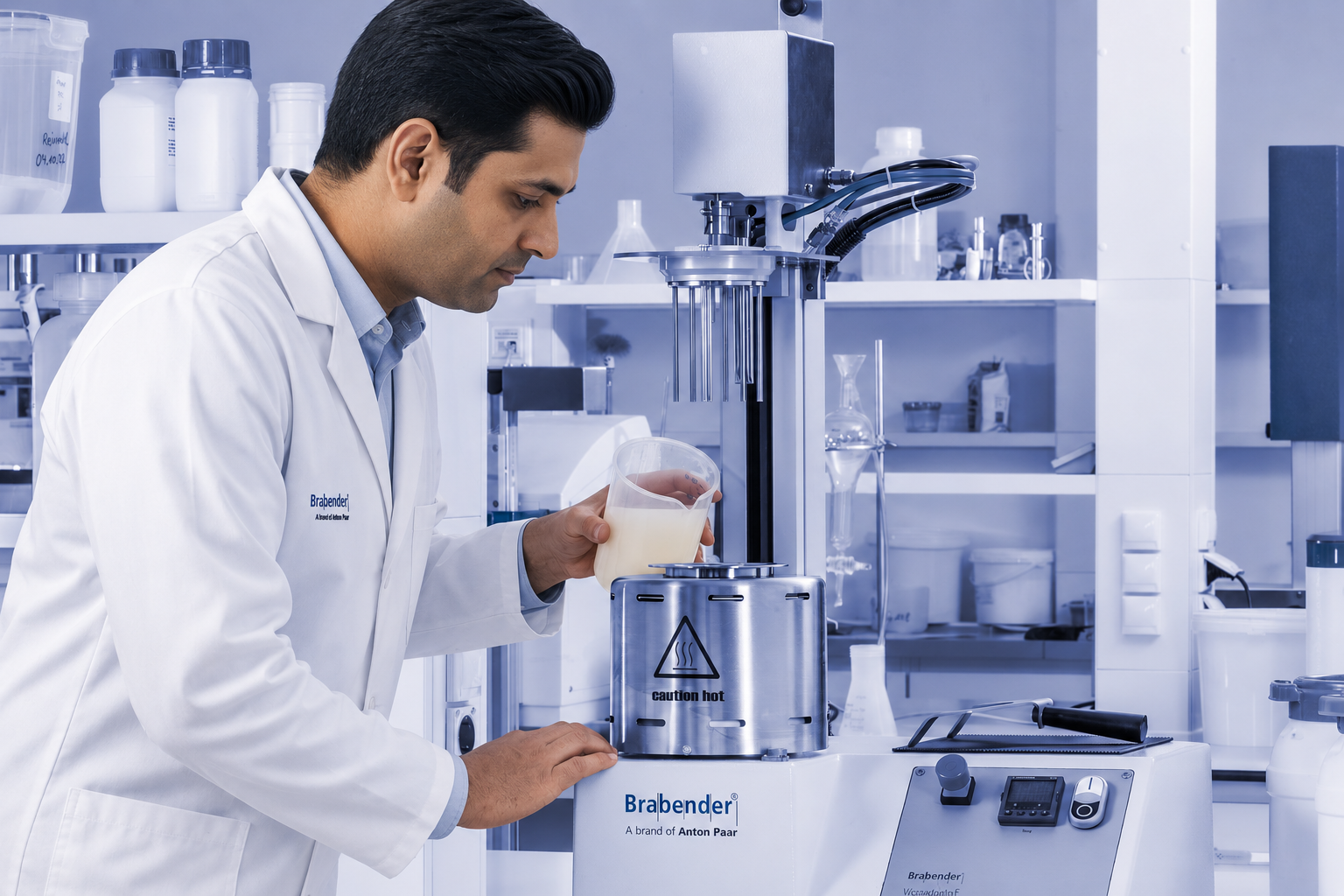
Our pregelatinized grade is specified against a Brabender Viscograph viscosity band measured on a 5% slurry, with whiteness, fineness, moisture, pH, starch content and foreign matter controlled to the published specification. Exact values for the grade you are evaluating are given on its technical data sheet.
Industrial applications
Pregelatinized tapioca starch is used wherever cold viscosity, film formation or binding is needed without a cooking stage.
| Sector | Typical process steps | Property being used |
|---|---|---|
| Paper & packaging | Surface sizing, coating binder systems, wet-end addition, packaging board | Cold-water make-up, film formation, adhesion to fibre |
| Adhesives | Corrugating and laminating adhesive formulations | Viscosity build without cooking, tack and film strength |
| Food processing | Instant soups, sauces, bakery and dessert mixes | Instant thickening, neutral taste and odour |
| Animal feed | Pellet and block binding | Binding at low dosage in cold processes |
| Textile | Sizing and finishing formulations | Film formation and controlled viscosity |
| Construction & technical | Thickeners and rheology modifiers in water-based systems | Cold solubility, consistent rheology |
Paper manufacturing applications
In paper mills starch is one of the largest-volume additives. Pregelatinized grades are used where starch has to be made up cold, or where a cooking system is not available at the point of use — surface sizing solutions, coating formulations that need a starch binder, and wet-end addition for dry strength and retention.
Selection depends on the position in the process, the target solids and viscosity at the size press or coater, and how the starch interacts with the rest of the formulation. Our dedicated paper guide covers each step in more detail.
Packaging applications
For packaging paper and packaging board the same functions apply, with additional emphasis on surface strength, printability and the performance of the board in converting. Starch is also used in the adhesive systems that hold corrugated and laminated structures together.
Adhesive applications
In corrugating and laminating adhesives, starch supplies viscosity, tack and the film that carries the bond. A pregelatinized fraction is commonly used as the carrier portion of the formulation because it builds viscosity at ambient temperature and stabilises the suspension of raw starch.
Relevant technical considerations
- Dispersion method — controlled addition under agitation prevents lump formation.
- Water quality and temperature — both shift hydration rate and final viscosity.
- Shear and holding time — viscosity can change between make-up and point of use.
- Solids concentration — small changes have a large effect on apparent viscosity.
- Storage — cool, dry conditions in unopened original packaging; the product is hygroscopic.
- Dust handling — apply normal fine-powder handling practice; see the safety data sheet for the grade.
How buyers should evaluate a pregelatinized starch
- Ask for the technical data sheet with test methods stated, not only typical values.
- Check that the viscosity specification names the method, slurry concentration and measurement band.
- Confirm batch-to-batch control: request certificates of analysis across several production batches.
- Review the safety data sheet and the certifications held before supplier qualification.
- Run a laboratory make-up that reproduces plant water, temperature, shear and holding time.
- Trial at pilot scale before committing to a production specification.
- Agree packaging, batch coding and traceability requirements up front.
- Confirm lead times, documentation and export paperwork for your destination.
Where to go next
Our pregelatinized grade, along with native, modified and custom-developed starches, is described with full specifications on the products page. If you are working in paper or packaging, start with the paper manufacturing guide.
Cite this resource
PREGEL WORLD. Pregelatinized Tapioca Starch: Properties, Applications & Industrial Uses. Available at: https://pregelworld.com/resources/pregelatinized-tapioca-starch-guide
Related pages
Need technical information or product documentation?
Technical data sheets, certificates of analysis and safety data sheets are issued on request for the specific grade you are evaluating, so you always receive the current revision.